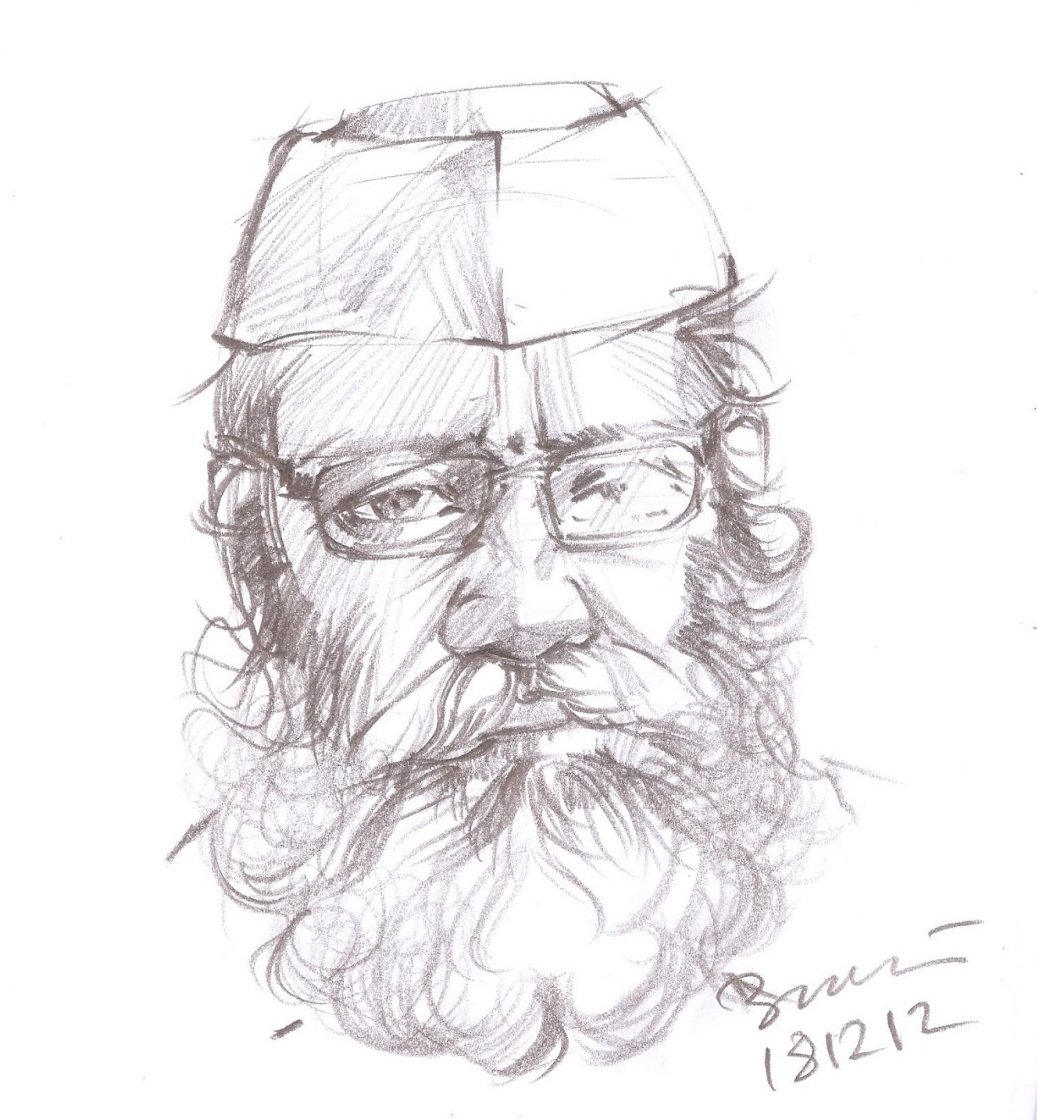
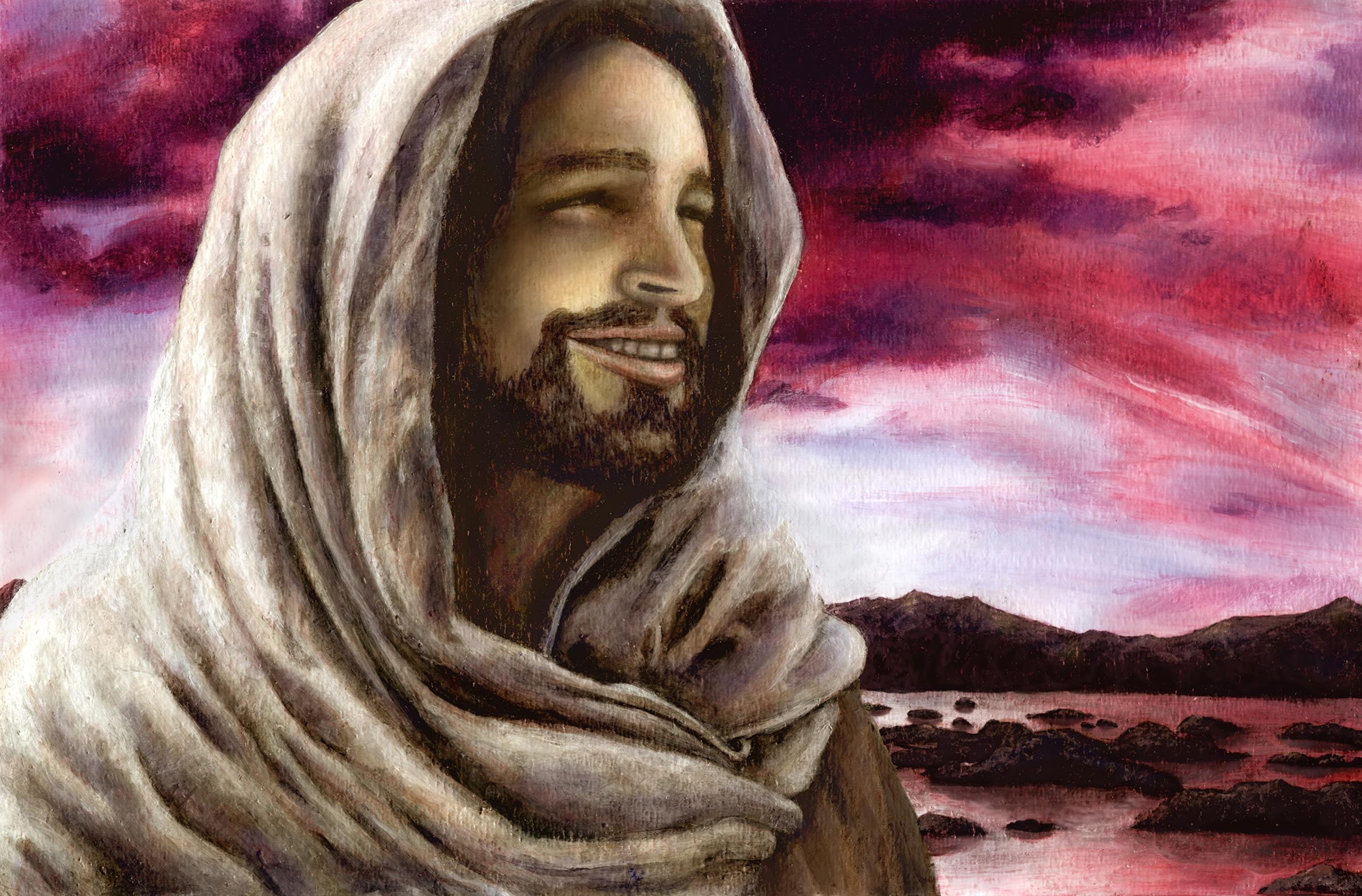
Face from aside (en profile)

Drawing by Jos Hogeling (Jogem), Drawing Academy students
This drawing is made last year.

This drawing is made last year.
We congratulate Coco Depink, who published five articles about fine art and received free access to first month of the Drawing Academy “How to Draw” video course.
Coco Depink’s articles:
– Study of an Oriental Head for “The Marriage at Cana” Gaetano Gandolfi
– Was Sir Anthony van Dyck using Phthalo blue?
– Giovanni Battista Tiepolo Apollo and Phaeton
– Paul Cézanne: Bathers in landscape
– Manetti’s Dido and Aeneas explained
Gaetano Gandolfi was the most talented member of a family of artists that dominated Bolognese painting in the second half of the eighteenth century. Early in his life he studied with his elder brother, Ubald; he later was a pupil of the sculptor-anatomist Ercole Lelli at the Accademia Clementina in Bologna. In 1760, under the auspices of an important early patron, Bolognese merchant Antonio Buratti, Gaetano and Ubaldo travelled to Venice for a further year of study. In Venice, Gaetano was deeply impressed by the art of Sebastiano Ricci and Giovanni Battista Tiepolo, painters whose fluent brushwork and effortless technique had a dramatic influence on his art…
Ovid in his Metamorphoses tells the story of Andromeda, the daughter of King Cepheus and Queen Cassiopea of Ethiopia. The mother’s claim to beauty so agreed the Nereids that Neptune sent a sea monster to ravage the kingdom.to free the country from his scourge, Chepheus was forced to sacrifice Andromeda. Anthony van Dyck depicted the moment of sacrificed Andromeda, chained to a rock near the monster lair, is rescued from her faith by Perseus, who flies above from his winged horse, Pegasus. The sea monster can be seen thrashing about in the waves below. The subject was a popular one among artists of the sixteenth and seventeenth century. Offering the challenge of portraying the female nude in distress. Both Rubens and Rembrandt painted the story of Perseus but this is the only example of van Dyck, who rarely painted mythological pictures…
I love and appreciate the Traditional multi-layer oil painting approach of the old masters. So much so, that I intend to create a body of work utilising this approach.
My question is: Where can I source such oil paints and purchase them? Any particular website or Company that possess these oils that are of good, professional Artist’s quality? These oils to venture into this approach could not be found locally. Please provide me with some legitimate source…
I did this drawing from imagination for the lesson 12 video. It was supposed to be a simple sketch, which I then rendered for practice as you mentioned is good to do sometimes in one of the lessons…
From time to time we all experience creative blocks, these can be some of the hardest times for an artist and it happens to all of us. Even if you don’t have such a problem at the moment, you might have in the future but either way being more creative can’t hurt. In this article I will show you 5 methods to be more creative and get back to creating right away…
Sophy Laughing (Soph Laugh) is a California-born artist who specializes in the conservation, preservation, and restoration of antiquities. Laughing began making studies of portrait drawings after visiting the Maastricht Fine Art Fair. Inspired by masterpieces held in institutions and in private collection, Laughing began exploring drawings of the Old Masters.
Sir Edward Coley Burne-Jones’ Study for a head for the painting THE CAR OF LOVE (1895) is one of Laughing’s favorite drawings. The drawing is a preliminary study for the head of a central female figure dragging the CAR mounted on huge wheels through the narrow streets of a city resembling Siena, which Burne-Jones visited in 1871. The male figures in the drawing are reminiscent of Michelangelo’s frescoes in the Sistine Chapel, where Burne-Jones spent many hours studying and copying Michelangelo’s male figures. While the painting remained unfinished at the artist’s death in 1898, the features found in this beautiful head study became Laughing’s muse, shaping her perspective of ideal female beauty, as portrayed in pencil. So entranced by her face, as well as by the illuminated faces painted by Raphael, Laughing has since studied portrait drawings of the Old Masters…
When Giambattista Tiepolo was called from his native Venice in 1730 by the Archinto family to decorate their palace in Milan, he was embarking on a career that would establish him as Europe’s foremost decorative painter. Tiepolo studied with Giorgio Lazzarini, but it was the vast ceiling paintings by Paolo Veronese, the sixteen-century master, and the impressive altarpieces of Giovanni Battista Piazzetta, Tiepolo’s contemporary, that had the most profound effect on his art. As early as 1726 Tiepolo was referred as ‘celebre Pittor’ (by the Udine town council) and his fresco decorations along with his sketches and easel paintings, where soon in high demand throughout Europe. He would enjoy an illustrious international career, working for the courts of Wurzburg and Madrid before dying in Spain in 1770.
Apollo and Phaethon is an extremely important record of Tiepolo’s painting cycle at the palazzo Achinto, which was destroyed by bombs in 1943. Unpublished and unknown to the scholarly community before it appeared at auction in 1985, the painting is directly related to a fresco that decorated the ceiling of one of the four reception rooms in the palace. It tells the story of the semi divine Phatheon who sought to prove his mother’s assertion that he was the son of the god Apollo. He did this by coaxing Apollo’s permission to allow him to drive the Charriot of the Sun, which the sun-god guided across the zodiac to usher in each new day. Apollo, who actually was Phaethon’s father, reluctantly agreed, but the young man, unable to control the feisty stallions in their charge across the sky, flew too close to earth, scorching it and creating the desert of Africa. The planet was spared total immolation by Jupiter, who halted Phaethon’s ill-advised ride by rocking him from the chariot with a thunderbolt…