Learn How to Draw Whatever You See or Imagine

DrawingAcademy

It is never “too late”

It is never “too late”…

Hi,

We recently received the following message in the Drawing Academy Survey from Omar.

Unfortunately, Omar didn’t provide his contact details; since we have no means to write him back directly, I’m posting this article in the hope that he will see the reply.

Omar’s message:

“I am 78 year young. I have painted and drawn most of my life. And I think that I am pretty good, for being self-taught. I am married for 55 yrs., no children, retired, living on a fixed income.

I was just reading about a painter that recently died. His bio said that from early in his life, he knew that he wanted to be a painter.

I just wish that that could be said about me. I have done everything to make a living except what I wanted to do. Shame, isn’t it? Thanks.”

Read More
How can I improve my rendering

How can I improve my rendering?

Dear Drawing Academy Tutors,

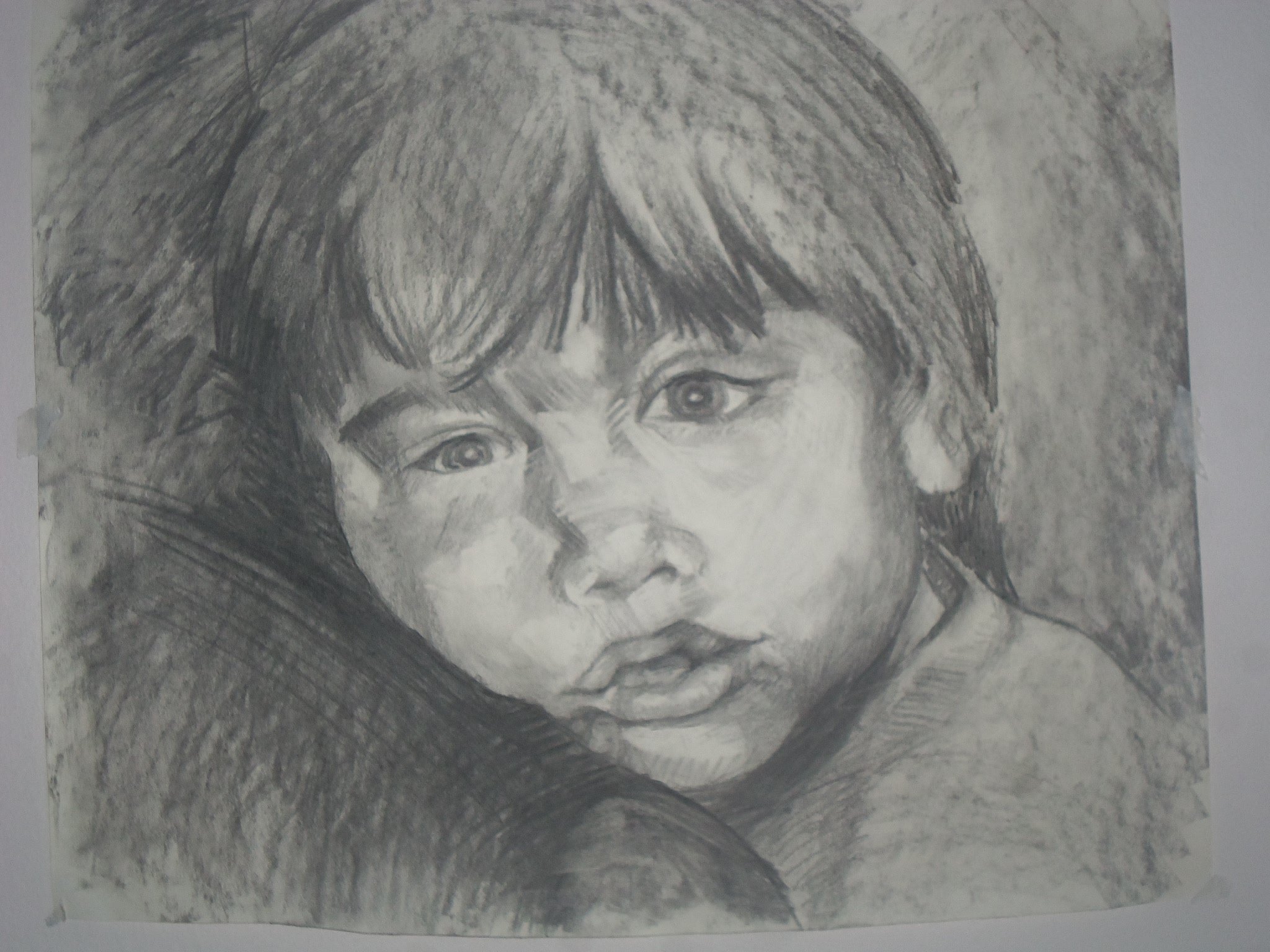
I’m having a difficult time rendering shapes tonally. I believe I am still much too dependent on hard lines to describe forms. This is why I think my drawing here appears two dimensional.

This drawing was done from a live model in charcoal. To me, it looks flat, and the shading is not very precise.

How do I improve my rendering skills so that my drawings look more three dimensional?

Read More

Leonardo da Vinci without a beard

Artwork by Levi

My Name is Levi, I’m 21 years old from Brazil.

I live in Sobral in Ceará, in the northeast of the states; there are no drawing schools here!

I am very interested in art! I would love to learn classical drawing from a teacher who really mastered it!

Traveling to other towns that are far away to study drawing is not an option for me.

Searching the internet I found the Drawing Academy, where I realized that this must be one of the best schools that teach traditional art! …

Read More
JOSE-JIMENEZ-ARANDA

JOSÉ JIMÉNEZ ARANDA – Part 3

Article by Carol GRACE de SOFIA, Drawing Academy student

JOSÉ JIMÉNEZ ARANDA – 1837-1903

In 1889, Jiménez Aranda’s brother Luis was awarded a prize for “The Hospital,” painted from the interior of a French hospital and meticulously detailed.

The piece received the Medal of Honor at the Spanish Pabillion during the Universal Expo in Paris. This marked a painting renaissance throughout Spain.

The Universal Expo of 1889 initiated a new trend in Spanish painting: Naturalism. José Jiménez Aranda said of his brother Luis’ artwork that “It is simple and logical. We know how to paint, but need to renovate ourselves.”

Only Great Masters are able to change their style—which is exactly what Jiménez Aranda did, proving once more his real talent. He had already mastered the Casaca style and earned a tremendous reputation, and even though he was over 50 years old, he completely changed course…

Read More
JOSE-JIMENEZ-ARANDA

JOSÉ JIMÉNEZ ARANDA – Part 2

Article by Carol GRACE de SOFIA, Drawing Academy student

JOSÉ JIMÉNEZ ARANDA – 1837-1903

In Rome, Jiménez Aranda worked for months, developing the details of his art and further personalizing each piece.

He planned his pictures in successive stages, determining in advance what he was going to paint, and in exactly what way.

The figures in his “cloak” (casacones) paintings were carefully studied. He constantly made sketches and preparatory drawings for each canvas.

He conducted rigorous research about the objects and clothes he included.
The attitudes and manners of his characters are natural and well-balanced, the figures relaxed and lacking any artificiality…

Read More
JOSE-JIMENEZ-ARANDA

JOSÉ JIMÉNEZ ARANDA – Part 1

Article by Carol GRACE de SOFIA, Drawing Academy student

JOSÉ JIMÉNEZ ARANDA – 1837-1903

An artist that demanded a tremendous amount out of himself…

José Jiménez Aranda was born in Seville, Spain, on February 7, 1837.

He was known for his plain yet elegant manners and for his fiery temper. He would display a gentle look as he made heartfelt, simple, and precise statements.

When observing a piece of art that he despised, he would make a very scrupulous and witty analysis of the piece, disregarding the creator.

Sorolla spoke of Jiménez Aranda as a Great Master of Art, as well as a gentleman of character and humility, from whom much could be learned, not only in matters of art but of personal conduct as well.

In 1848, when Aranda was 14, his father enrolled him in the Royal Academy of Fine Arts of Santa Isabel of Hungary, located in Seville, Spain, where he would himself teach in his late years. His Tutors were Don Antonio Cabral Bejarano, the patriarch of Sevillian painting and an excellent artist in his own right, and Don Eduardo Cano de la Peña, an innovative teacher who would encourage his students to look for inspiration from life, transgressing the Academic standards of the time…

Read More
The shepherd and the dancer

The shepherd and the dancer

artwork by Lucian HRAB

I am not a professional artist. I only have this hobby since my childhood and in this way I spent some hours. I left it completely for few years and without any explanation the flame just rebirth this year.

Since, I was searching on internet for some interesting materials in order to help me to learn good drawing habits in the proper way. I finally found this site drawingacademy.com and was impressed by the quality of this course. You are doing a very good job! …

Read More
how-to-draw-figures-models

Can I learn to draw figures without a life model?

Hi,

My name is Daniel and I’m from Germany. I’ve been trying to learn to draw for a few years now. What inspired me to this is that I’ve been quite a fan of Japanese Manga. So I’ve bought a book on “How to draw Manga” which unfortunately was of almost no use to me. It had a lot of images and explanations on specialized topics but it didn’t really improve my drawings.

I realized that what I was truly looking for is something that can teach me the basics, the fundamentals of drawing. Something that will give me the skill to draw whatever I see or imagine.

So I’ve read some books which were widely recommended for teaching exactly that. I can’t say that they were bad, in fact I’ve learned some things that improved my drawing skill a bit. Anyway I’m still not at a level that I can draw confidently the things I see or imagine.

So when I stumbled over this website on YouTube it caught my interest instantly. After watching the free video previews I realized that Drawing Academy was exactly what I’ve been looking for all the time. That’s why now I’m quite sure that I’m going to enroll in the Drawing Academy as soon as I finish my busy work at university.

I have the following questions:

Can I learn to draw the human figure without having access to a life model?

I can only access tutor questions by the link provided in the e-Mail Newsletter. I can’t find them anywhere on the website.

Read More

Gamut of pencil strokes

Drawings by Steven Nielsen, Drawing Academy student

Vladimir,

I was attempting practice shading and gamut of pencil strokes. Here’s Sarah’s portrait. I feel that I may have overdone this drawing.

I feel I need to work on my hatching skills either I am impatient or I just hatch in a controlled chaos type of way.

I will be going to local studio on Wednesdays soon for life model drawing and I am a bit nervous about this as I am not the fastest drawer, but we shall see how this works out! …

Read More
Michelangelo’s Sistine Ceiling

Michelangelo’s Sistine Ceiling

Article by Clayton Cogmon Jr.

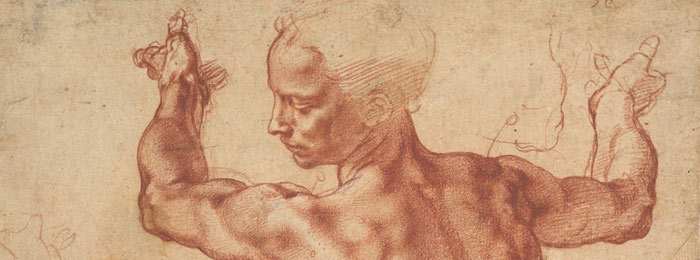
Just about everyone knows about the great sculptor Michelangelo. However, it was very surprising to discover that not too many people know that this great sculptor was also a great painter; his most famous painting (or should I say paintings), was the nine paintings on the Sistine Chapel ceiling. These paintings are considered cornerstone works of High Renaissance art.

The Sistine Chapel ceiling was painted between the years 1477 and 1480. The project was given to Michelangelo by Pope Julius II. Michelangelo was very reluctant to accept this project given the fact that he was primarily a sculptor and had not painted in fresco ( a technique of mural painting executed upon freshly laid lime plaster) in around twenty years. He also stated that: “Painting was for women.” The Pope however, was insistent, so Michelangelo was forced to accept the strenuous project…

Read More
Life Drawing Academy
Old Masters Academy
Watercolor Academy
Anatomy Master Class