
Question from Daniel Trpka
Hi Vladimir,
What do you think about a sight-size drawing method?
Many artists say that sight-size is not good for imagination and memory drawing.
French artists from 18-19 century (Bouguereau, Gerome, Cabanel…) had excellent imaginary paintings.
Thanks
Hi Daniel,
Many thanks for your question.
The sight-size method can produce very realistic, almost photographic results, including photo-distortion in perspective.
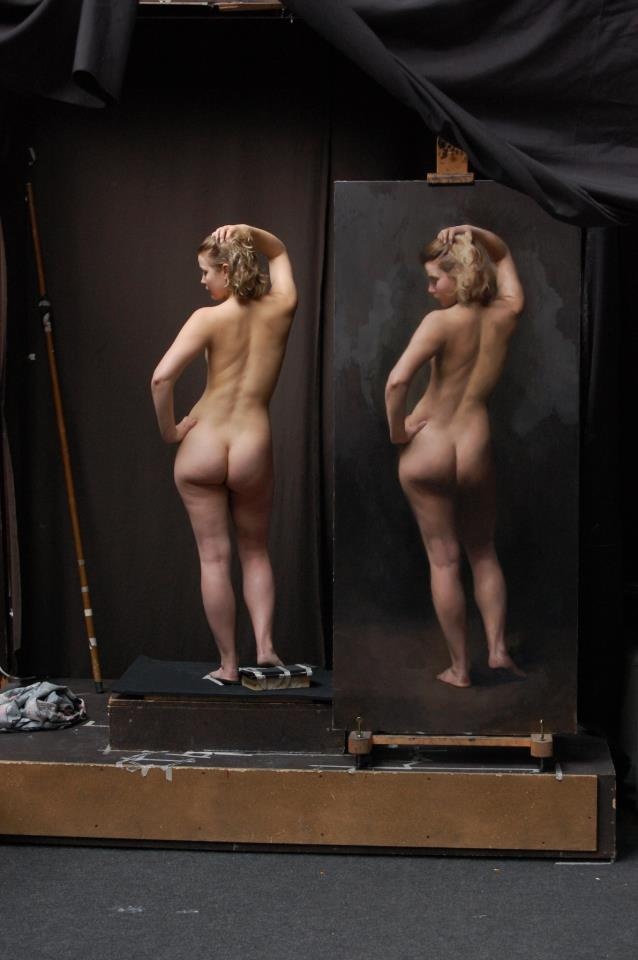
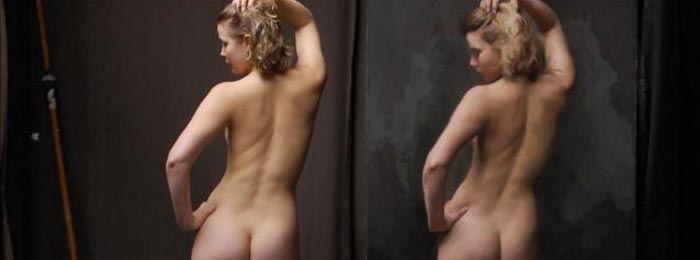
The sight-size method of drawing is depicting an object on a 1:1 scale, as it appears to the artist.
In this method, the artist places paper or canvas in the same field of view as the model and uses levels, strings, sticks, or other similar tools to copy that subject in exactly the same size as seen from his or her point of view.

Please note:
When an artist can only draw by relying on drawing aids like sticks, strings, compasses, etc., he or she will face difficulties if those tools are taken away.
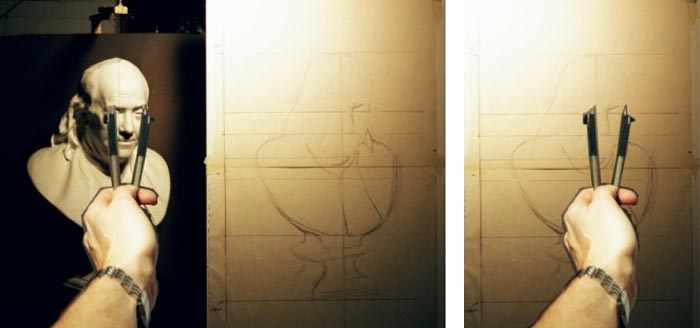
Before the invention of photography and other means of mechanical reproduction, the main objective of sight-size method was to achieve high accuracy in portraying objects and models.
This method can greatly assist untrained artists to make realistic-looking drawings. It is an easy shortcut to producing drawings, but it only trains you to make copies. I think this is the main appeal and the reason why various schools and atelier use sight-sizing.
You have to ask yourself what skills you want to develop.
Do you want to be able accurately copy objects exclusively in a life-size ratio?
Or do you want to be able to draw realistically whatever you see, think, or imagine, in any size of your choice?
The second skill-set gives artists much greater creative freedom and genuinely enhances their abilities.
Because the sight-size drawing method is based on copying, it is easier.
However, it does not develop such necessary skills as constructive drawing, the use of perspective, or an understanding of human anatomy.
Becoming an original fine artist takes more than just being able to copy an object.
The sight-size method will not help with drawing from memory or imagination.
You will develop better drawing skills when measuring by eye and checking it with a pencil, called the “comparative measurement method.”
I hope this helps you to decide whether to learn drawing by sight-sizing (as used in some atelier) or the comparative measuring method, which will enable you to draw from life, memory, and imagination whatever you see, think or imagine.
In the Drawing Academy course, we will teach the latter.
Kind regards,
Vladimir

I learned to draw portraits in the sight sizing method. My portraits came out pretty close to the photo without any knowledge of facial proportions or anatomy.
One would make a black and white A3 size photo state of a portrait. Then everything would be measured with a proportional divider. With the divider one could enlarge the A3 a bit, but it was done with a tool.
I first started to learn the comparative method in the Life Drawing Academy. It is a very helpful and necessary skill to have.
Combining this with learning proportions of a face, is one of the ways I am breaking away from relying on copying photos with the sight sizing method.
My portraits looked stiff and like the person was wearing a mask though. I am convinced it would change now that I am learning new skills.
This is very helpful – also Liezl’s comment.
Thank you for this discussion. It’s very difficult for a beginner to find the right tools to learn better drawing with creative impulses.
Dear Vladimir:
I appreciate your teaching. I believe John Singer Sargent utilized same sight sizing for many of his portraits.