Article by Ayyub
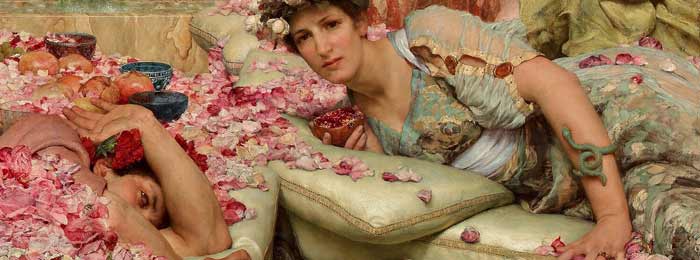
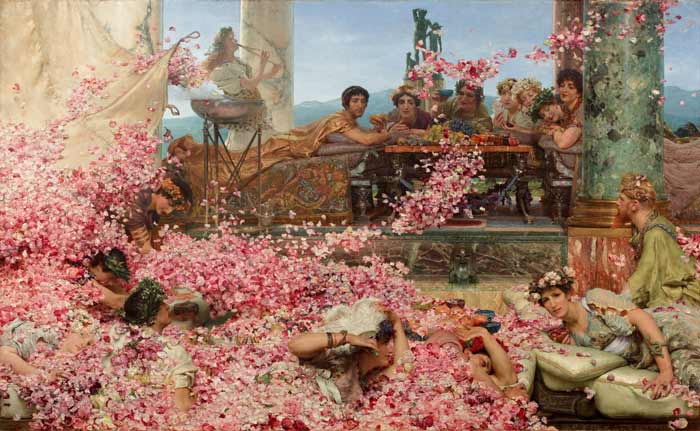
The Roses of Heliogabalus is a painting done by Sir Lawerence Alma-Tadema in 1888. It was commissioned by Sir John Aird, 1st baronet and is now held in the private collection of Spanish Mexican billionaire Juan Antonio Pérez Simón. This painting might look romantic and colorful at first glance. However, once you know the story behind the cruel party of Elagabalus, you will see the hedonistic indulgence and petty indifference of the hosts towards the guests.
The Roses of Heliogabalus
By Sir Lawrence Alma Tadema
To understand the painting and the themes behind it, we will refer to the history of ancient Rome. Marcus Aurelius Antoninus (He was born as Sextus Varius Avitus Bassianus then was posthumously known as Elagabalus.) was a teenage emperor of Rome between 218 and 222 AD. His name comes from the Syrian sun god Heliogabalus as he was the head priest of this god in Emesa, Syria. From his biographies in Historia Augusta, we learn that Elagabalus was infamous for sexual debauchery, replacement of the chief god Jupiter to Heliogabalus, and other despisable accounts. (By the way, note that the authenticity of Historia Augusta is very debatable with many historians agreeing it is mostly fiction, but that is not important for now.) In one of these accounts, the author claims that Elagabalus had once hosted an orgiastic banquet where guests had bathed in absolute depravity. After tons of drinking and sexual exchanges, a reversible ceiling flipped releasing a swarm of perfumed and lovely flowers. There were so many flowers that a few guests allegedly suffocated to death. Lawerence Alma-Tadema takes this narrative and transforms it into his own special painting.
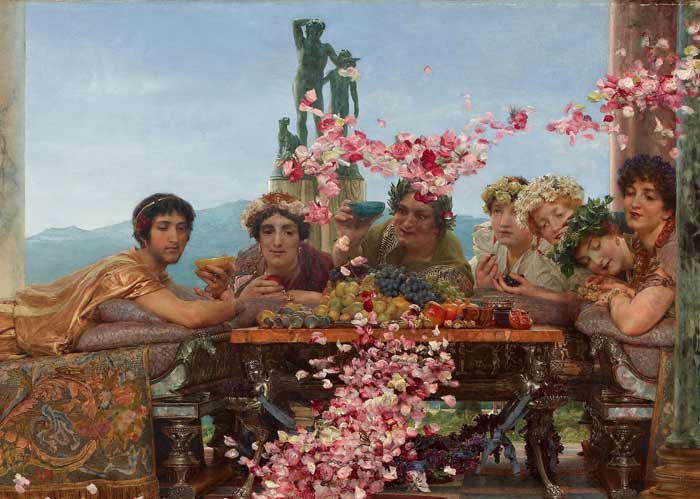
Closeup of Elagabalus and Hosts
In the composition of this painting, there are sixteen figures evenly divided from top to bottom with eight figures above representing Elagabalus and the hosts, and eight figures below representing the unfortunate guests. With such decision, the painting has established the division of Roman high society against the civilians. The figures below bask in the deathly beauty of flowers under them before their terminal breath. Some figures show complete unawareness of their situation because they are too deep in ecstasy to realize what is going on except for two of them. There is a man who is staring at Elagabalus wondering why the teenage emperor would do such a thing, and a woman who stares directly at us which breaks the fourth wall. I believe Alma-Tadema does such a thing in order to make us part of the painting as if we were one of the guests. The seven figures above are the hosts of the banquet. Their expressions show that they are enjoying the spectacle in front of them. Death and suffering became their spectacle, and they cherish every moment they get to see.
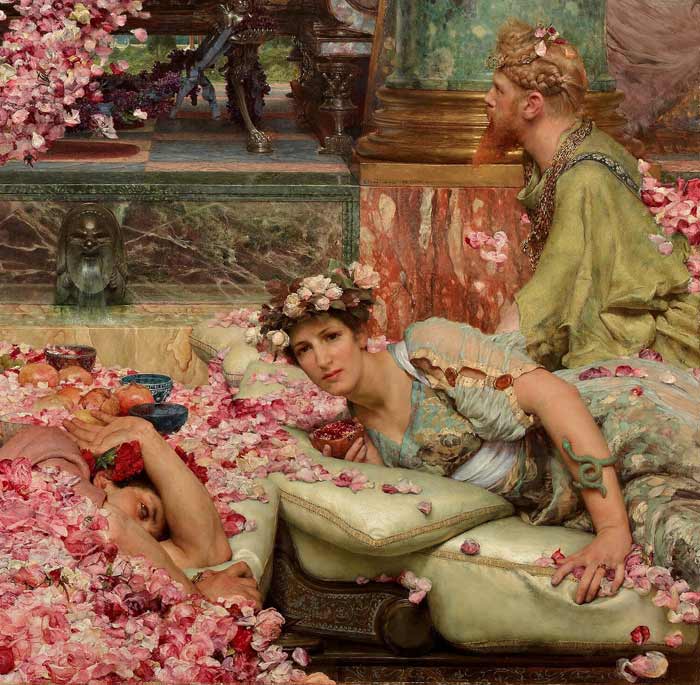
Closeup of Guests
The eighth figure on the far left is a woman dressed in leopard skin which is a maenad. Maenads are followers or priestesses of the Roman god of wine, Bacchus. They are ecstatic women who worship Bacchus through wine and dance. Such a figure is added to the composition to emphasize the madness and ecstasy, but the references to the wine God do not stop there. Above the hosts, we see a statue of Bacchus, his lover Ampelos, and a panther next to them. The panther is a central animal in Bacchic worship as it represents and reinforces untamed nature and ferocity of the banquet. All these Roman mythological elements tie together to tell and emphasize the themes of imperial excess presented in this painting.
I would like to mention that there is one interesting historical change Alma-Tadema has made in this painting. While it is inaccurate, this change has helped get the message of the artwork across Victorian audiences. It is stated that Elagabalus used violets to drown his guests in Historia Augusta, but violets in Victorian floriography represented humility and modesty. Obviously, Elagabalus in this narrative was not humble nor modest. Therefore, Alma-Tadema swapped violets for roses instead. Roses represent strong passion or emotion. In this painting, they symbolize lust. The painter requested that roses be sent to him from France every week during the four months of painting to paint each rose petal with detail and care.
The Roses of Heliogabalus is one of my favorite paintings from the Anglo-Dutch artist. While I am not really interested in Greco-Roman mythology, it was very lovely to see how Lawrence Alma-Tadema managed to combine Roman mythology with a historically inaccurate but crucial Victorian element to weave the most beautiful but deceiving depiction of lust and decadence.