Drawing Trees in Black Ink
In this video lesson, you will see the process of Drawing Trees in black ink. You will also discover the Composition Rules and Golden Proportion application.
Enroll in the Drawing Academy Course
Pay once - Enjoy forever!
Only $297
Drawing Trees – Rendering Details in Black Ink
When it comes to drawing trees, endearing small details in tree foliage can be quite laborious; however, it doesn’t mean you have to depict every single leaf. Instead, leaves can be grouped together and numerous groups be drawn with curly outlines.
Short dashes and parallel hatching make foliage darker in tone when drawing trees. Diagonal hatching also unifies separate leaf groups together.
The land next to the road and small bushes are also done with due attention. The drawing in such areas is more suggestive than descriptive; it helps to engage the viewer while leaving some room for imagination.
The road has vertical and horizontal dashes. Vertical dashes help to establish linear perspective, while horizontal short strokes give texture to the ground.
Drawing Trees – Composition Rules
When drawing trees, you need to consider the composition rules that can be applied for this drawing. This artwork composition has its own character and balance. The composition framework is built on the Rule of Thirds. They say this rule comes from the era of the Old Masters, dating back to 1797 and mostly applied to landscape pictures.
According to the Rule of Thirds, the artwork is divided into three equal parts horizontally and vertically. The viewer’s attention is most likely to be drawn to the lines that separate those parts and to the points of intersection of those lines.
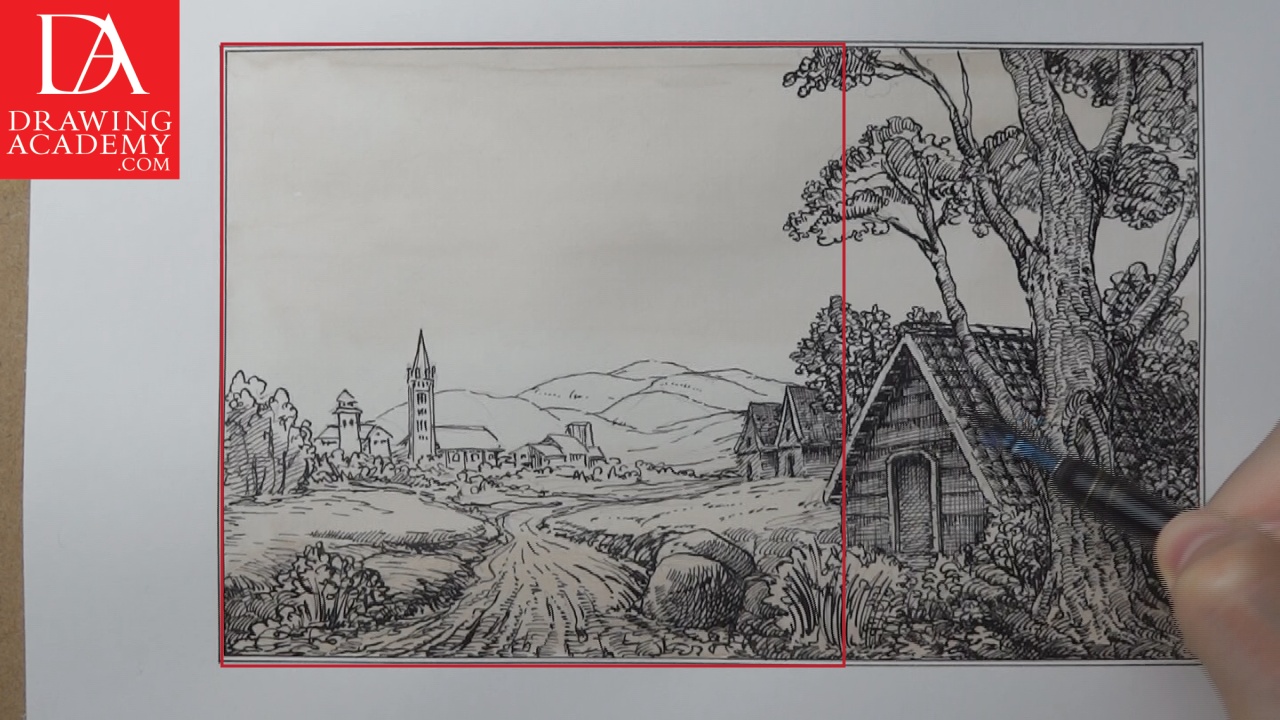
Another composition rule we can check is the Rabatment of the Rectangle. The landscape artwork has a rectangular shape. The human eye is always looking for the simplest forms and a square is simpler than a rectangle. So, subconsciously, the human eye looks for a square first. This square will be the first portion of the landscape we register visually and then expand our attention to the remaining part of the artwork.
These two rules: Rabatment and Thirds, are simplified versions of the Golden Proportions. In the Drawing Academy, I have dedicated a series of videos on the topic of Golden Proportions. This proportion can be found in all aspects of organic life as well as in the non-organic world.
The Golden Ratio, also known as Golden Proportions, Divine Proportion, Golden Section, Extreme and Mean Ratio, can be described mathematically as:
The sum of “A” and “B” is in the same proportion to “A”, as the proportion of “A” to “B”. This proportion is equal to 1.618…
One of the figures that follow the Golden Proportion is a Fibonacci spiral. Such spiral also can be used as a guide for the drawing composition.
Of course, creative drawing is not a precise science and you are not expected to know all the rules of proportions nor calculate ratios with decimal points. So, when drawing trees, there’s no need for a ruler or calculator. With time and practice it should happen automatically. Your trained eye and hand will find the most pleasing sizes and locations for your drawing objects.
Until then, only practice will make your drawings perfect and perfect drawings are the foundation of all arts.