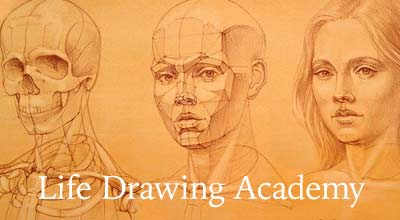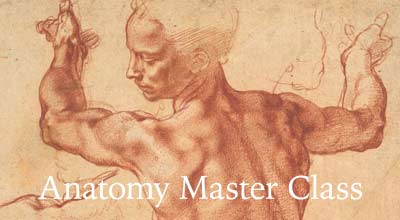

Look at a page of drawings by Leonardo, Dürer or Repin and one thing stands out before any question of style. These artists knew what they were drawing. A shoulder is not a vague outline with shading added on top. It is a joint with bones beneath it, muscles that pull in known directions and a form that turns in space according to the rules of perspective. Their drawings convince us because they were built on understanding, not on copying appearances.
That understanding did not come from talent alone. For more than three centuries, the great art academies of Europe taught drawing as a discipline with its own body of knowledge, learned in a fixed order, step by step. It is worth remembering how they did it.
Leonardo’s order of study
Leonardo da Vinci left a clear instruction for the young artist in the notes later gathered as his Treatise on Painting. The student, he wrote, should first learn perspective, then the proportions of things, then study under a good master, and only after that go on to nature and to his own work.
The order matters. Perspective and proportion come first because they are the grammar of drawing. Without them, a student who sits in front of a model can only guess. With them, every line has a reason: the student knows where the horizon lies, how a form shrinks as it recedes, and how the parts of a figure relate to the whole.
Leonardo practised what he taught. His anatomical studies, made from dissections, are still among the most precise drawings of the human body ever produced, and they were made by a painter who wanted to know what lay beneath the skin he painted.
Dürer and the science of measure
In Germany, Albrecht Dürer followed the same path. He published a treatise on measurement with compass and ruler in 1525, and his Four Books on Human Proportion appeared in 1528, shortly after his death. In them he worked out systems of proportion for figures of different types, using geometry to construct the body rather than tracing its outline.
For Dürer, a painter who did not understand measure and geometry was working blind. His books were written so that German artists could learn the principles that the Italians had developed, and they became a reference for generations of students.
The academies give the method a home
The first academy devoted to drawing, the Accademia delle Arti del Disegno, was founded in Florence in 1563 under Cosimo I de’ Medici, with Giorgio Vasari among its founders. Its very name placed disegno, drawing and design, at the heart of all the visual arts. The Académie royale de peinture et de sculpture followed in Paris in 1648, and in 1757 the Academy of Arts was founded in St. Petersburg, later the Imperial Academy of Arts.
Across these institutions, the curriculum shared a structure. Students studied geometry and perspective. They learned anatomy and the proportions of the figure. They drew simple geometric bodies and plaster casts of classical sculpture, where form, light and shade could be studied without the movement of a living model. Only after years of this preparation were they admitted to the life class.
Chistyakov: to draw is to reason
The Russian tradition gave this method one of its most famous teachers. Pavel Chistyakov taught at the Imperial Academy of Arts in the second half of the nineteenth century, and his students included Ilya Repin, Vasily Surikov, Valentin Serov, Mikhail Vrubel and Vasily Polenov. Few teachers can claim a list like it.
Chistyakov insisted that drawing is an act of thinking. A student had to understand the construction of a form, its planes, its volume and its position in space, before rendering its surface. A line put down without knowing why it belonged there was, to him, a mistake, however pleasing it looked. His system of constructive drawing shaped Russian art education for decades and remains the foundation of the academic schools that continue his work today.
What the old method teaches us now
The strength of the academic method was its sequence. Each skill prepared the next: perspective before the figure, the skeleton before the muscles, simple bodies before complex ones. Nothing was left to chance or to a happy accident.
That lesson reaches beyond the studio. Anyone who plans a course of study, from a drawing master to a schoolteacher, faces the same question the academies answered: what must come first so that the next step makes sense? Teachers who bring art into their own classrooms can find practical ideas for planning it in this guide to arts in education from EMStudio. The principle, though, is as old as Leonardo: knowledge first, then the work.
The Old Masters were not born knowing how to draw a hand or a head in perspective. They were taught, patiently and in the right order, by people who believed that drawing could be learned. The drawings they left behind are the proof.