Artwork by Rhonda, a Drawing Academy student
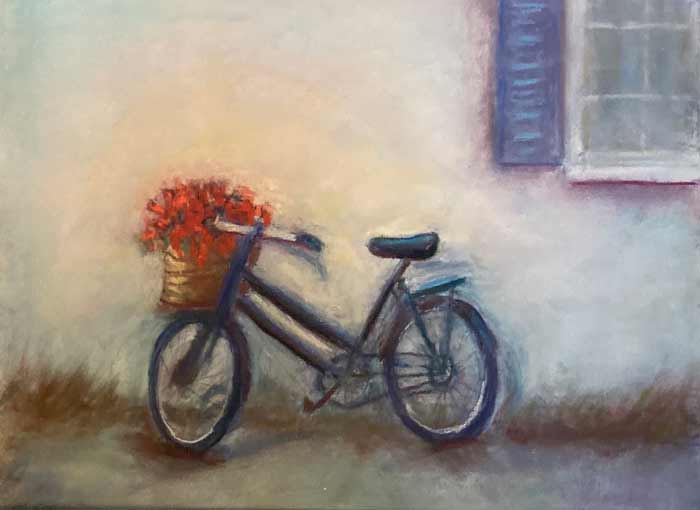
Flowers For Sale by Rhonda Whittington
Pastel, 9″ x 7″
“Can you please critique this painting? I know the back wheel is not right, but I don’t know how to fix it.”
Rhonda
Dear Rhonda,
Thank you for your wonderful artwork; I like it very much. This piece has a charming, quiet atmosphere. The bicycle, flower basket, pale wall, and shuttered window create a simple but engaging story. The strongest aspect is the mood: the artwork feels poetic and personal rather than overly descriptive.
Composition
The composition works well overall. The red-orange flowers create a strong focal point, while the bicycle frame leads the eye toward the saddle, rear wheel, and window. The large area of empty wall is also effective because it gives the composition space to breathe. The window, however, is quite strong visually and competes slightly with the bicycle. Softening its contrast could help keep the bicycle as the main subject.
Color
The color harmony is one of the painting’s strengths. Warm flowers contrast beautifully with the cooler blue-violet notes of the bicycle and shutters. The subtle yellows, greens, greys, and violets in the wall also give the background life without making it too busy. Slightly clearer warm and cool relationships in the light and shadows could create more depth.
Creativity and expression
This is perhaps the most successful part of the work. The edges dissolve into the atmosphere; colors move gently through the wall; details are suggested rather than exhaustively described. The flowers have energy, while the bicycle itself has a slightly worn, personal character. There is also a pleasing contrast between the geometrical subject and soft handling. A bicycle consists of circles, straight tubes and mechanical components, yet here it has been treated poetically. That gives the artwork personality.
Constructive drawing of the bicycle
The main area for improvement is the constructive drawing of the bicycle. Bicycles are difficult subjects because their geometry is very precise. The centers of both wheels, the axles, frame, fork, pedals, and saddle all need to relate accurately to one another. Establishing these main structural points before adding details would make the bicycle feel more solid and convincing.
The wheels deserve particular attention. Since they are circles seen at an angle, they should appear as carefully constructed ellipses. In this artwork, the front and rear wheels do not completely follow the same perspective.
Here are some useful tips for fixing these wheels and drawing circles in perspective:
– A circle in perspective will appear as a perfectly shaped ellipse
– Such an ellipse must be fully symmetrical
– The main (long) and additional (short) axes of an ellipse must be perpendicular to each other
– The direction of the short axis must direct the virtual vanishing line into the vanishing point
– This direction must be strictly perpendicular to the main axis of ellipse
– The degree of foreshortening depends on the viewing angle
– A well constructed ellipse can be inscribed into the side of a cube that follows the same perspective
I understand that all these tips might be difficult to take in altogether without studying first such basic concepts as how to draw geometric shapes and fundamental rules of perspective.
So, here’s the most useful concept – if you imagine an object, in this case a bicycle, inside a cube or cuboid, it would give you a better picture of the object spacial position and how its parts (wheels) should look in the given point of view.
To get the geometry of the bicycle wheels right, you need to learn how to draw circles in perspective. This is an important topic that helps to draw not just circles, but everything with round shapes – cylinders, cones, spheres, vases, architecture, human head and figure, and so on.
In the Life Drawing Academy Correspondence Course, students learn such things starting from simple tasks, such as how to draw a cube in perspective, how to draw a cube with circles inscribed on its sides, how to draw cylinders and other geometric objects, and advancing to such topics as how to construct human figures using what they learn about perspective and other constructive drawing principles.
The basket could also benefit from slightly stronger construction. This does not mean that everything needs to become rigid or mechanically precise. Correct construction can remain underneath loose and expressive marks.