Article by Ayyub
Raja Ravi Varma was one of the most successful Indian artists during the other half of the 19th century for using European fine art techniques to tell epic tales of Hinduism and Indian culture. Indian painter and art critic Gulam Muhammad Sheikh asserts that Varma had left his impact on contemporary Indian art. Out of all the paintings Raja Ravi Varma created, the one that intrigues me the most is his painting of the Hindu goddess Kali because to me, it has been an introduction to the Hindu religions, its beliefs, and the gods they worship. It’s definitely hard to get it at first if you practice any Abrahamic religion like I do, but that just goes to show how beautifully diverse Hinduism is. The story of Kali is just one of the many stories that encompass Hindu belief.
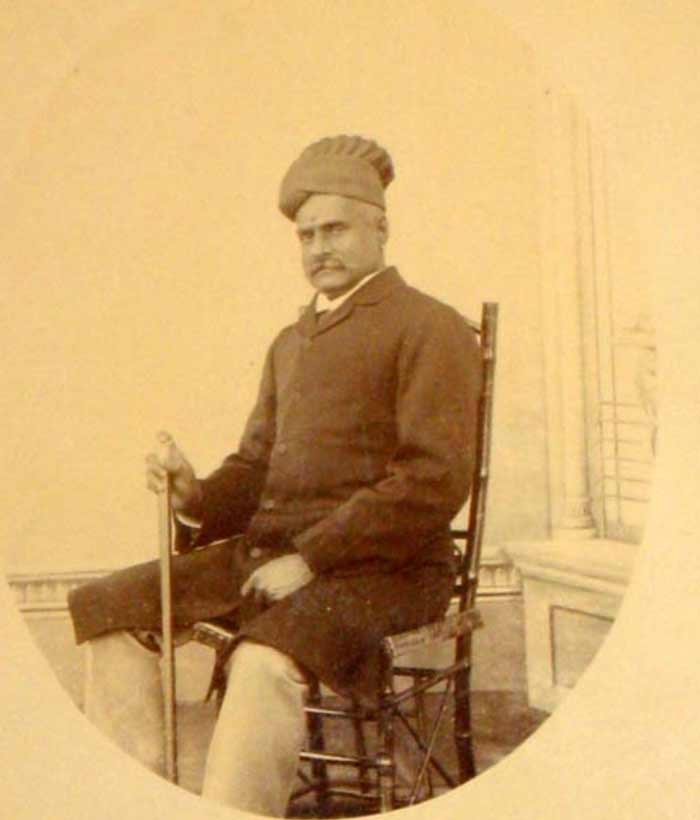
Raja Ravi Varma
This painting of Kali illustrates her most famous legend: the battle of and triumph over a malevolent asura named Raktabija in the Hindu text named Devi Mahatmyam. According to the text, Raktabija had a boon where if one drop of his blood landed on the ground, a copy of him would emerge that would be as strong as him. This made the asura virtually indestructible, which assisted him in his mission to overthrow the Hindu gods, and he, along with other demons, constantly wreaked havoc all through Earth as a result. Amidst the chaos, the goddess Durga as well as other deities sought to bring Raktabija’s terror to an end. Because of the asura’s invulnerability, it seemed impossible to fully take him and his clones down, as the more he was wounded, the more his blood would spill, and the more clones that would appear. This is where the powerful goddess Kali emerges from Durga and ensures that no drop of Raktabija’s blood reaches the blood by endlessly drinking it. Even after the death of the asura, Kali went into a fury in order to eliminate all evil from Earth, but her rage was becoming beyond what was necessary to the point where the gods asked Shiva, her husband or consort, to intervene. Shiva then approached Kali and lay down in front of her, and it was only when Kali stepped on Shiva’s chest that she realized what she was doing and calmed down immediately.
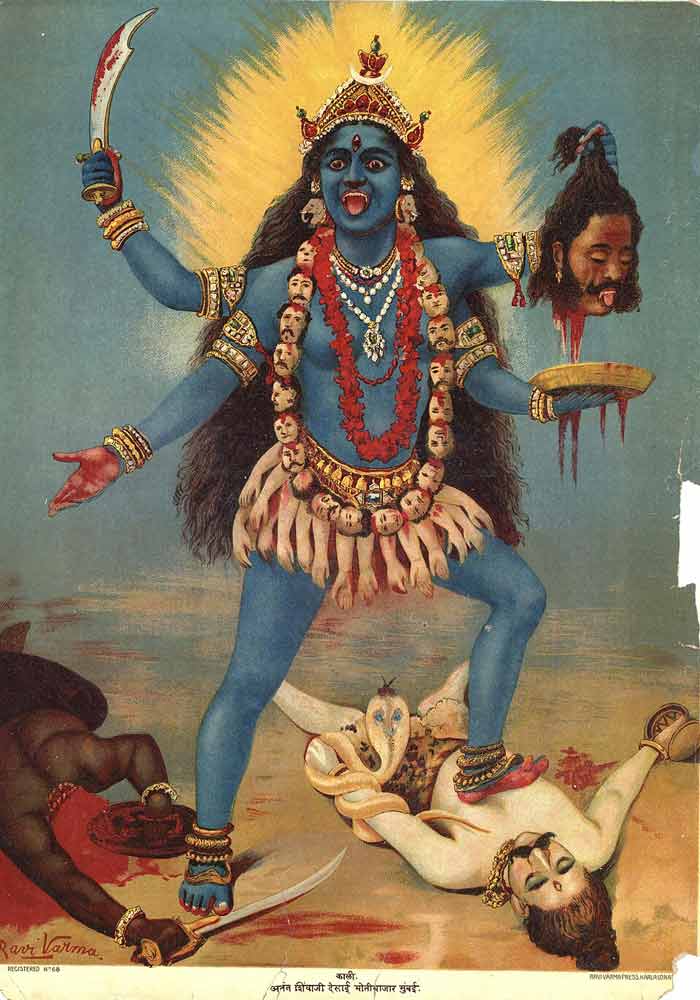
Kali by Raja Ravi Varma
Knowing that this is a religious piece of work, we should understand the iconography and symbols around Kali. Starting with the four arms, it is important to know that most Hindu gods and goddesses have multiple arms to emphasize their divinity, along with her three eyes to show her enlightenment. Kali holds a sword with her upper left arm and the devil Raktabija’s head with her upper right arm and plate under it to catch his blood. Raktabija’s death is the death of human pride and arrogance as the sword symbolizes divine knowledge that cuts through ignorance and ego.
Regarding Kali’s downward left arm, I have not found much about it in this particular painting. However, I believe Kali does a hand gesture similar to one called “varada mudra”, which is a gesture to bestow the wishes of devotees. Take this claim with a grain of salt as this is just speculation based on what I have researched.
The most interesting aspect of Kali’s iconography is her right foot on Shiva’s chest. Shiva is consciousness while Kali is movement; they cannot function alone. If it were only Shiva, there would be no life and no change, and if it were only Kali, there would be rampant destruction. There is a saying in Sanskrit that states, “Shiva without Shakti [Kali] is Shava [corpse].” The saying states that if Shiva, the still and unmoving awareness, is not accompanied by Shakti, the dynamic action, Shiva remains inactive like a corpse. Likewise, if Shakti is not accompanied by Shiva, Shakti becomes directionless and destructive. The relationship between Shiva and Kali represents the necessary co-dependance of awareness and action in order to participate in creation.
By the way, Kali can also be presented with pitch-black skin or extremely dark blue skin to the point it looks black. That dark skin represents the cosmic void, boundlessness, and eternity within Kali. Her skirt of severed arms depicts the detachment from karma and the earthly, while her wreath of heads displays the seemingly never-ending cycle of birth and death.
Finally, we should talk about Kali’s lolling tongue. The tongue has multiple interpretations. Some say that her tongue represents her unending passion under the control of her white teeth, which represent purity, in order to symbolize internal transformation. Other folklore interpretations say that the tongue showed Kali’s embarrassment at the realization that she was stepping on her husband’s chest and stuck out her tongue in shame.
Understanding all of this, we conclude that Kali is the protective mother to Hindu devotees from evil. By annihilating ignorance and fear, Kali becomes the symbol of raw transformation and liberation. She shows that destruction of ego and pride is required to carve paths of spiritual creation all while balancing it with the silent but aware Shiva. Discovering Hinduism has been like finding a new lens to see the world, and it looks like I am more inclined to explore the world with such a lens.
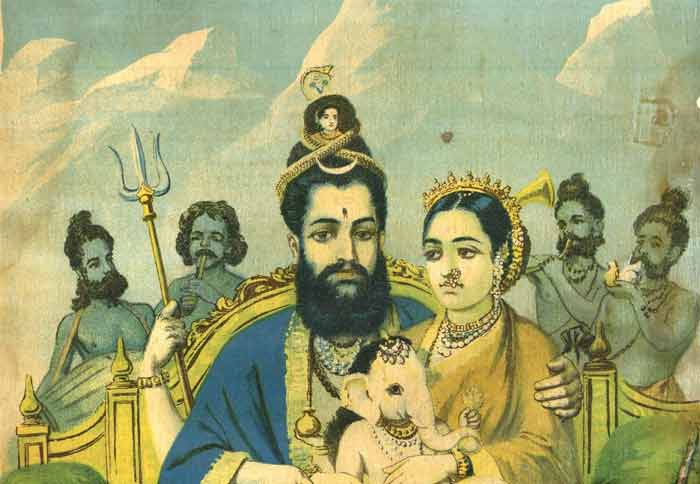
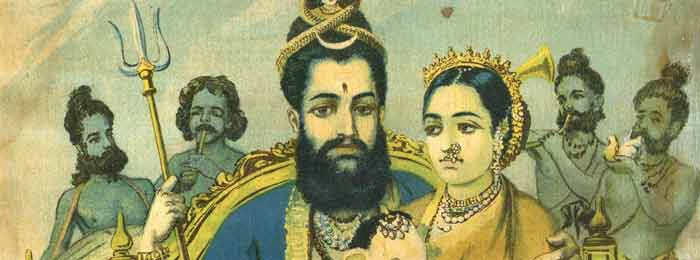
Shiva and His Consort Parvati by Raja Ravi Varma