Article by Ayyub
In my journey of studying fine arts and the history of arts, I have recently begun appreciating the beautiful form of artworks known as “tondo”. The name “tondo” comes from the Italian word “rotondo” that literally means “round”. They are paintings or sculptures enclosed in a circular canvas or composition, and they have skyrocketed in fame during the Italian Renaissance. Later throughout art history, artists have created their very own tondos. Since I believe that tondos aren’t really getting the attention that they deserve today, I compiled a list of four tondo paintings and sculptures from multiple periods of art history in hopes of showing you the appeal of them.
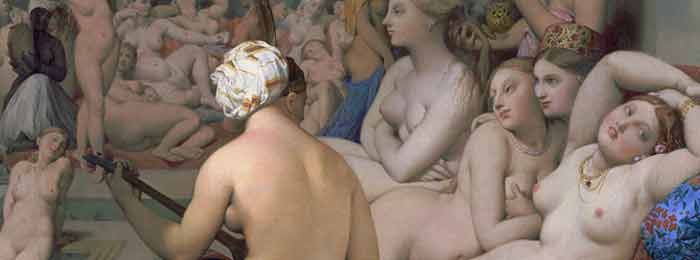
The first tondo I would like to show is Jean-Auguste-Dominique Ingres’s “The Turkish Bath” completed somewhere between 1852 and 1859. Now originally, the painting was in a rectangular composition. That was when Ingres decided to modify his painting and turn it into a tondo in 1862. The painting depicts the orientalist scene of a Turkish bath (hammam) full of naked and voluptuous women that just added to Ingres’s and many other orientalists’ fantasies. For such a theme, switching from a rectangular to a circular composition was a good decision. I believe so because the circular composition makes us feel we are in the scene with the women or that we are seeing the scene with our own eyes. By having or resembling an eye-like design, the tondo adds to the voyeurism of the scene for the Western audience and the mystery and arousal surrounding the Eastern world at that time especially when some orientalist artists depicted fantastical, erotic, and mystical Eastern scenes conjured from their imagination rather than what Eastern culture actually was.
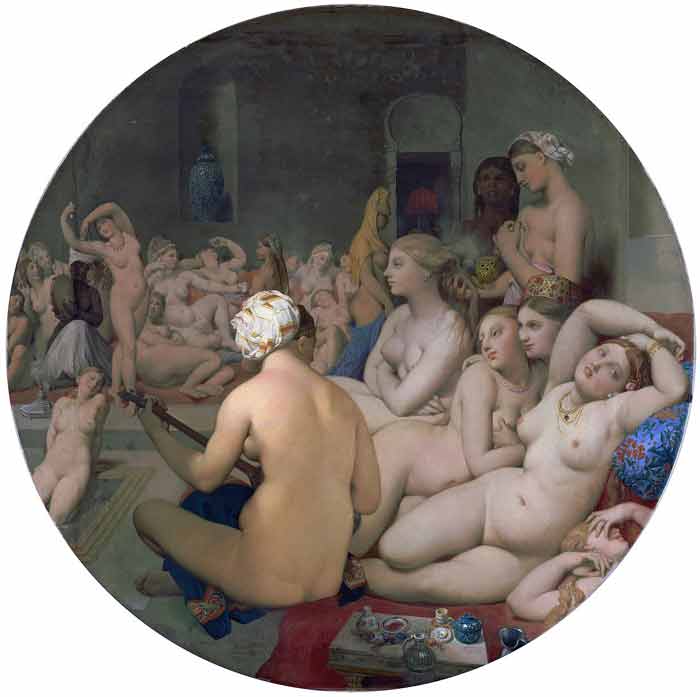
The Turkish Bath by Jean Auguste Dominique Ingres
Let’s go back to the Renaissance and look at Sandro Botticelli’s “Madonna of the Pomegranate” tondo. The “Madonna and Child” was a very ubiquitous subject for Renaissance artists and beyond and Botticelli was no exception. The Renaissance was also where the tondo started to rise in fame from ancient Greek art. In this painting, the Virgin Mary and Baby Jesus stand in the middle of the composition with 6 angels, 3 on each side, standing beside them with lilies and roses to show the love and purity of the Virgin Mary. Here, the tondo is used to make the focus of the composition Mary and Jesus right at the center of the painting. The most interesting thing about this artwork is how Botticelli incorporates the human heart in the painting by drawing the pomegranate to imitate cardiac anatomy down to how the fruit is positioned in the composition. The open pomegranate also serves as a symbol of Jesus’s death and sacrifice to the world in Christianity, and that is what the viewer is meant to be reminded of, the future suffering of Baby Jesus and Mary, when they look at the painting.
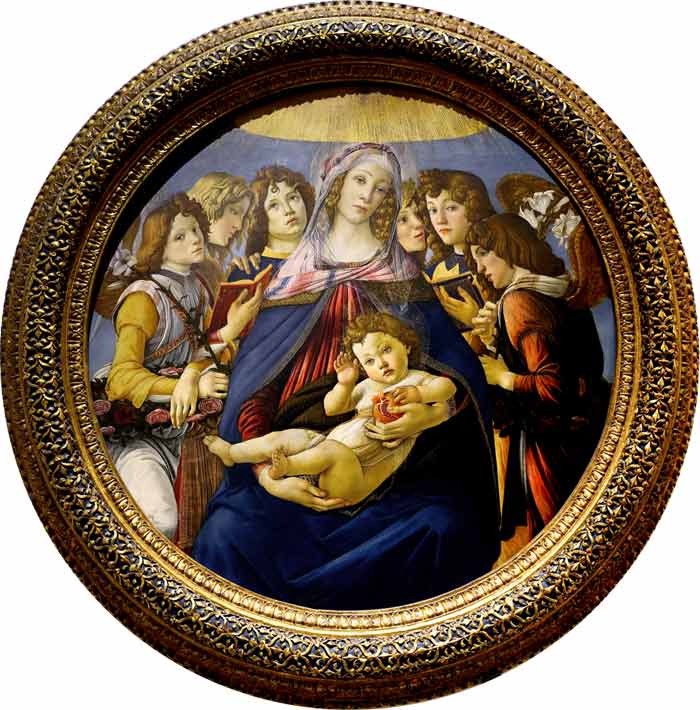
Madonna of the Pomegranate by Sandro Botticelli
The next tondo piece that I really love is a sculpture of yet another Madonna and Child by Andrea della Robia. Andrea della Robia was an Italian Renaissance ceramic sculptor whose uncle Luca della Robia, who was very well known for his glazed terracotta sculptures, became the most important artist for it, and he popularized its use in the Renaissance. Andrea became his uncle’s pupil where he learned this technique and later used it to sculpt this beautiful depiction of Mary and Jesus called “Madonna and Child with Cherubin”. Like all depictions of Madonna and Child, and this is something I didn’t mention earlier back with Botticelli, is their sorrowful expressions even for Baby Jesus. This is because they are devotional images meant to remind the viewer of Jesus Christ’s mission which it to make the message of redemption heard by every human on Earth, and the suffering he went through to bring that for us.
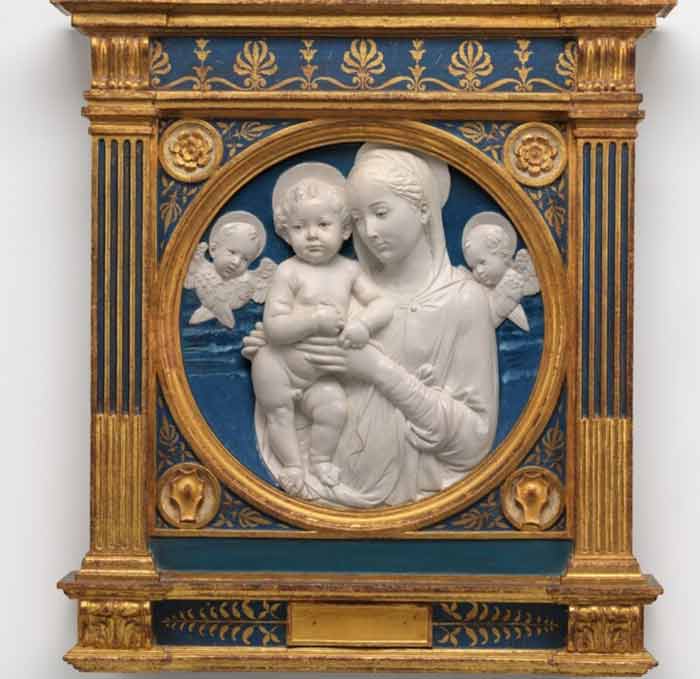
Madonna and Child with Cherubin by Andrea della Robia
I saved the best tondo piece for last. The painting “The Last of England” by the English painter Ford Madox Brown is the painting that stuck with me the most from this list. Even though the canvas’s is more of an oval then a circle, it still counts as a tondo as long as the canvas is round in shape. The painting depicts a couple with stricken faces sailing away from their home country England to reside in Australia for the rest of their life. Brown was inspired by Pre-Raphaelite sculptor Thomas Woolner’s own departure to Australia to paint this scene despite not being part of the Pre-Raphaelite Brotherhood himself. You can see the mother holding on her baby’s hand while the father hold the umbrella over both of them as if it is raining or will rain soon. In Ford’s own diary, he describes a pair of men behind the main couple in his painting as shaking their fists and cursing the land of their birth. The beautiful thing about this painting is that the couple in it are based on Brown and his wife Emma, the baby’s hand the wife is holding is based on their second child Oliver, and the little girl in the background eating an apple is based on their eldest child Catherine.
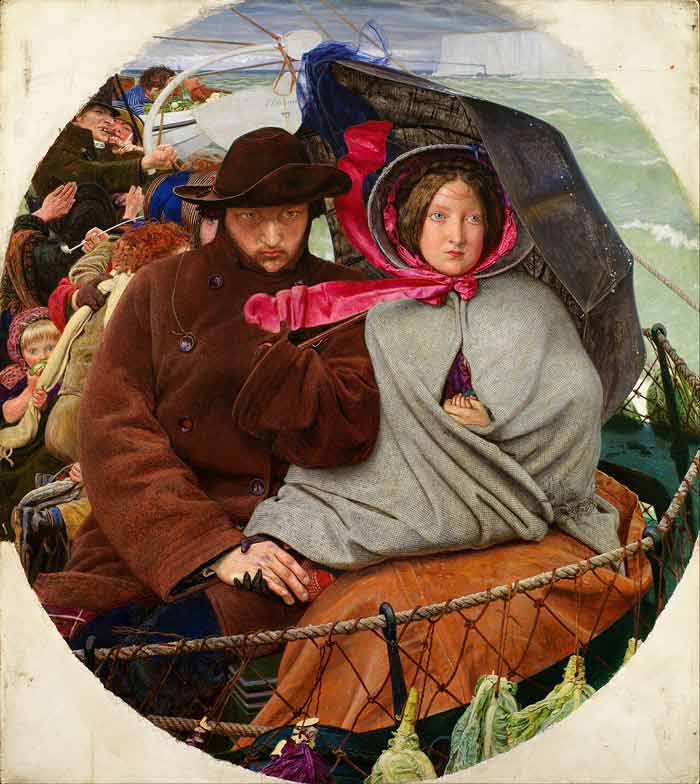
The Last of England by Ford Madox Brown
I am not sure what strikes me with love when it comes to tondo paintings. Maybe it could be their shape, deviant from the normal rectangular format, which attracts the viewer. It might help in composition to really emphasize a focal point. It might also help in symbolism where the circle is infinite and never-ending. Whatever the case may be, tondos will always have a special place deep down in my heart.