Discover How to Draw a Horse’s Head in Realistic Style
In this video lesson you will discover How to Draw a Horse’s Head in carbon pencil, on a toned paper.
Enroll in the Drawing Academy Course
Pay once - Enjoy forever!
Only $297
Head of the Horse of Selene Drawing
This “How to Draw a Horse’s Head” video lesson is based on the marble head of the horse of Selene, goddess of the moon, was carved around 438-432 BC. It is one of the sculptures from the east pediment, or gable, of the Parthenon, a temple set on the Acropolis in Athens, Greece.
The Head of the Horse of Selene sculpture is displayed in the British Museum, London, and is perhaps the most famous and best loved of all the sculptures of the Parthenon. The horse’s head is just over 80 centimetres long – about life-sized – ending just at the level of the jaw-line, and is carved from white marble.
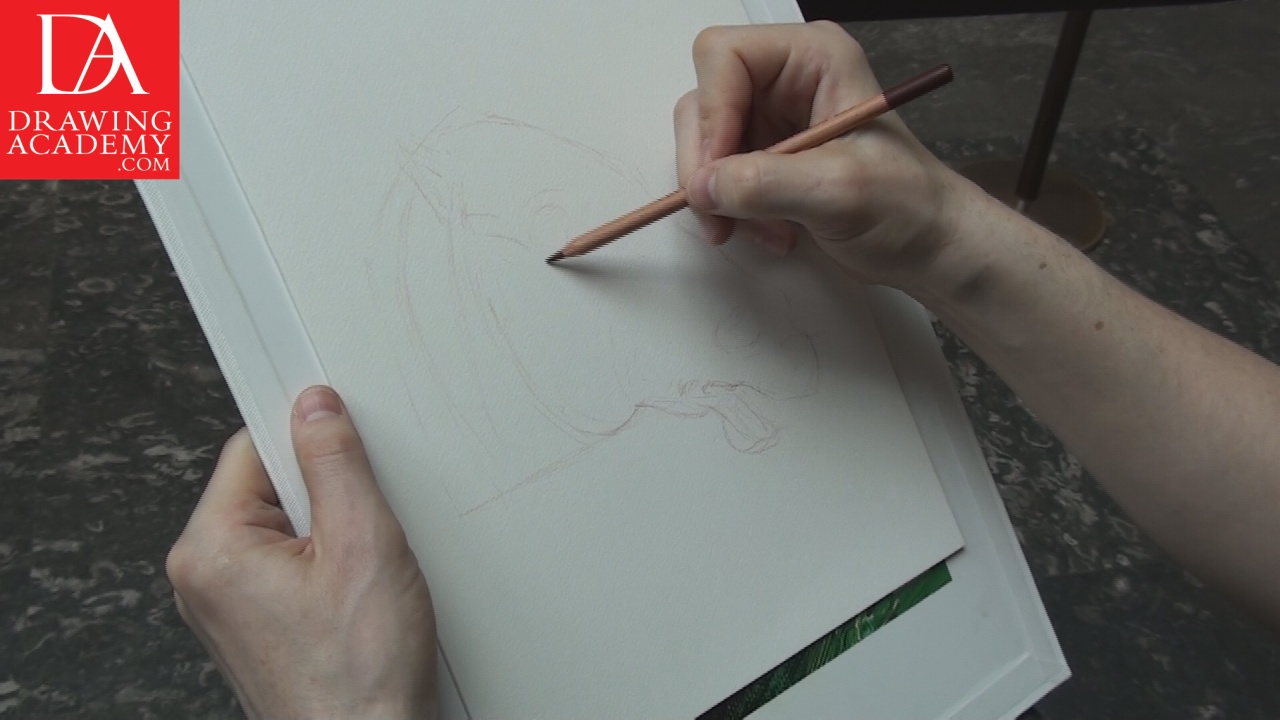
In this “How to Draw a Horse’s Head” lesson, I’ve presented how several sketches of horse’s head were done in the British museum, drawing from the actual sculpture. The purpose of such exercise is to become familiarised with the proportions of the marble, and to choose the point most appealing to a viewer; meaning a future carbon pencil drawing would benefit from the best view of this sculpture. The preliminary sketch is done in red pencil, on white paper.
The next step in this “How to Draw a Horse’s Head” video is to create a preparatory drawing, in the size we decide to go for, for the final artwork. Toned paper is selected for the final artwork, and this helps to protect its freshness. It is advisable to use this intermediate step, so that it will limit the amount of re-drawing (and eraser use) on the toned paper.
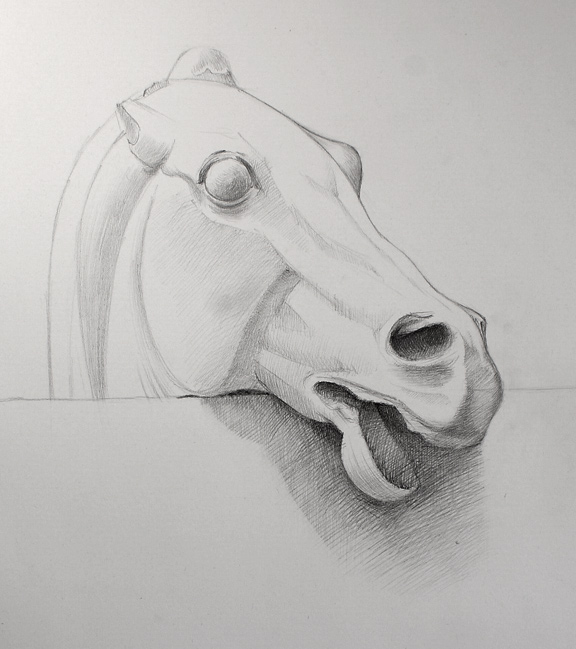
The more professional the artist is, the less time he, or she, spends concentrating solely on one particular piece of a drawing.
Create the drawing by working on various areas simultaneously; do not try to finish one particular piece of the drawing before starting on another.
In this way, you are keeping a fresh perception on the progress of the overall drawing, and your eyes are not getting too used to any particular feature.
This will help you to see mistakes in the drawing construction, or in any of the proportions.
It is better to come back to the same part of the drawing 10 times, after working on other parts, rather than trying to finish it in one go.
The Head of the Horse of Selene Sculpture
The horse head sculpture is a part of the sculpted group of figures that once filled the very centre of the east pediment. This group of sculptures showed the birth of the goddess Athena, from the head of her father, Zeus. The figures that represented Athena and Zeus are now lost; however, the head, of one of Selene’s horses, is shown here. Others are preserved in Athens.
The horse’s jaw would have hung over the edge of the pediment floor. The sculptor has captured the very essence of a beast at the utmost limits of its physical endurance. A long night spent drawing the chariot of the Moon through the sky, has left it exhausted and gasping for breath. The skin seems to be stretched over its bones, and taut against the great flat plate of the cheekbones. The nostrils are distended; the round, pupil-less eyes bulge with effort; the veins and sinews stand out; and what remains of the ears, lie almost flat against the head. The tongue lolls in the gaping mouth.
The horse’s mane has been cropped into an elaborate style, and stands erect, like the bristles of a brush. The back of the horse’s head is carved in detail, which is surprising, because once fixed on a pediment, the back would not be seen. The creases in the skin, as the horse turns its head outwards, follow the curve of the jaw-line. The sculptor has used the natural veining in the marble, to echo the angle of the line from the ear to the jaw. The grey veining cuts through the eye, and runs down towards the muzzle.