How to Draw a Male Head – Rendering shades in graphite pencil
In this video part you will discover how to draw head drawing techniques.
Enroll in the Drawing Academy Course
Pay once - Enjoy forever!
Only $297
How to Draw Head
When it comes to how to draw head drawing approach, the classical way of progress with the portrait drawing is to have it completed at any given time. The picture is not finished, but it is already an easily recognizable portrait. The proficient fine artist works on the classical drawing in such way that the process can be stopped at any moment and the portrait will have a likeness and be believable.
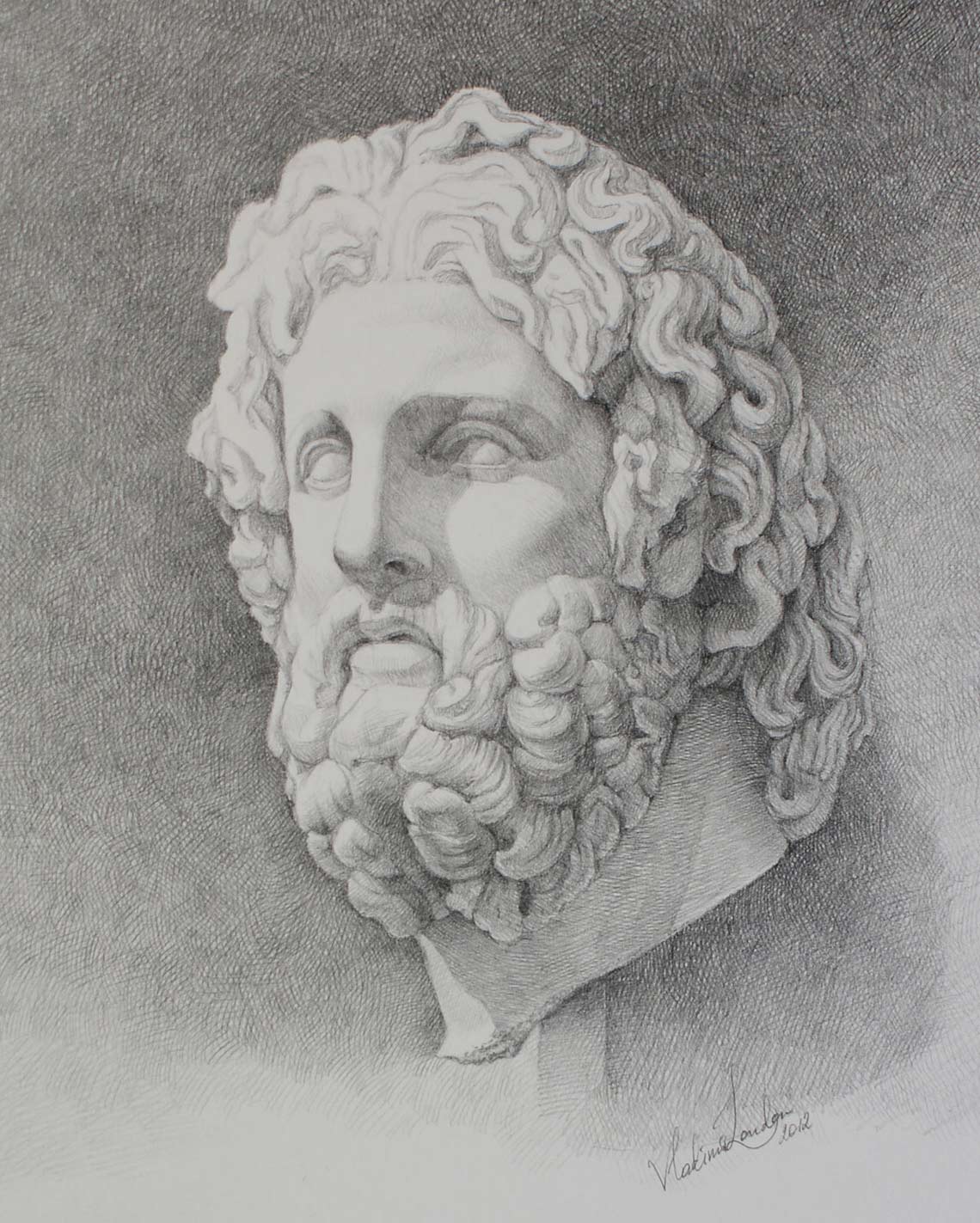
Using the classical methods in how to draw head traditional drawing approach, the artist will gradually increase the tonal values of the drawing – starting from the darkest areas – and work toward the lightest. In this way, the artist has great control over the progress as the drawing develops.
The three-dimensional nature of the Asklepios’ head is depicted on the flat surface of the paper with the help of shades rendering. Starting with the shadows, we make an illusion of head planes being turned away from the light source.
Once again, we are more interested in the general light and shade balance rather than particular small details.
When rendering shades, using traditional how to draw head method, think about the three-dimensional nature of the head and apply pencil strokes in the direction of the head contours. A contour is any imaginary line on the surface of the object, which can be revealed by making a cross section of this object.
When rendering with graphite pencil, make sure that you lift the pencil off the paper surface at the end of each stroke. Graphite pencil is a wonderful tool; do not make the mistake of using it as if it is a felt pen. Every line in graphite pencil contributes to revealing the shape of the objects you are drawing. Graphite hatching portrays the texture and material of an object, as well.
Varying the direction, shape of lines, their length and pressure on the pencil will result in a wider gamut of the drawing. A wide gamut makes a picture more interesting to look at.
Drawing the complicated structure of the Asklepios’ hairs is quite a laborious task. A beginner can be overwhelmed with such intricacy of curls and details. It is also very easy to get lost in such a great variety of tonal values.
To simplify this process, think about the hairstyle not as a bunch of curls randomly located on the head, but in terms of big unified hair masses, which have common volume and shape. When you have a mental picture of the big shape, then it will be easier to keep the complex collection of individual curls under control.